 Check ToDo Life

A look at Charles Duhigg’s habit loop and a small everyday experiment to explore what triggers a familiar action and what you get from it.
You open a social app even though you only meant to reply to one message. You return to a familiar activity even though you decided that morning to spend the evening differently. In moments like these, it is easy to blame a lack of discipline.
In The Power of Habit, journalist Charles Duhigg suggests taking a closer look at repeated actions: what sets them off, and what do we get from them? That can be a starting point for a small experiment with your own behaviour.
Editorial note. This article discusses the book’s ideas and offers everyday examples of how to explore them. The examples are our own: they do not report the results of a scientific experiment or promise the same outcome for everyone.
Three questions about a familiar action
Duhigg uses a model with three elements: a cue, a routine and a reward. The cue starts the sequence, the routine is the familiar action, and the reward is what makes the sequence worth repeating. This framework is central to the author’s explanation of habits. See the official study guide.
Consider a hypothetical situation. You finish a difficult work call and open your social feed.
- Cue: the call has ended, and you want to switch off for a moment.
- Routine: opening a social app.
- Possible reward: a brief break or something interesting to look at.
The word “possible” matters. Perhaps you want to catch up on the news. Perhaps you want a distraction from an unpleasant conversation. The same gesture does not necessarily tell you why you are doing it.
First, explore what the habit gives you
In the book’s practical appendix, Duhigg suggests identifying the routine, experimenting with rewards, isolating the cue and making a plan. He also explicitly warns that there is no single recipe for changing every habit. See his Reader’s Guide to Using These Ideas.
For our example, you could try several options. After one call, stand up and look out of the window. After another, take a short walk. On another occasion, deliberately set aside a few minutes to read the news.
The aim is to notice the differences. Which option gave you the pause you wanted? Which made it easier to return to work? When did the urge to open your feed remain?
Your notes can be brief: “after a difficult conversation”, “wanted a distraction”, “the walk helped me switch gears”. You do not need a detailed diary.
Takeaway. Before choosing a replacement for a familiar action, try to describe what you want to get from it.
What a small experiment might look like
Suppose you notice that you need a break after work calls, but your social feed regularly stretches that break beyond the time you wanted to spend.
Here is one possible plan, suggested by our editorial team:
After a call, I get up from my desk, pour a glass of water and take a few minutes to rest. Then I return to my next task.
While trying this out, you could keep your phone off the desk and close the social media tab. That gives the new action a prepared place in your routine.
There is no need to change your sleep, meals, work and leisure all at once. Start with one situation that is easy to recognise and describe.
If the replacement does not fit
Suppose you take a break but still open your feed. That is a reason to reconsider your explanation.
Perhaps you wanted some conversation, which a walk did not provide. Or perhaps the next work task was so unclear that you did not want to return to it. In that case, look separately at the task itself: what exactly is the first step?
For this everyday experiment, “What happened in this situation?” is a more useful question than a sweeping judgement about your discipline.
Editorial note. We are discussing ordinary everyday actions. This framework should not be used to assess or treat an addiction on your own.
Who might find the book useful
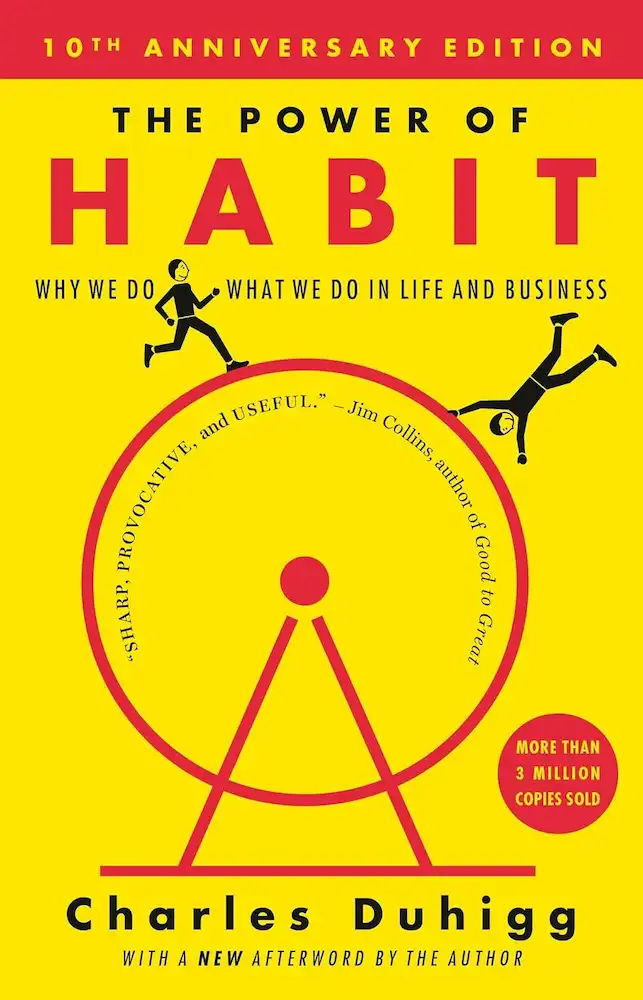
The Power of Habit may interest readers who want to understand Duhigg’s model of repeated behaviour. He develops the subject through stories about people and organisations, taking the book beyond personal routines. More information is available on the author’s official book page.
As you read, distinguish between a story that illustrates an idea and evidence that a particular technique will help you. An interesting example can give you a question to explore; your own outcome still needs to be tested.
You can start with one note: “In what situation do I keep doing the thing I wanted to change?” There is no need to promise yourself a complete life overhaul on Monday.
Takeaway. Choose one repeated action, observe the circumstances and try a small change. Judge it by whether it helps in your situation.
Photo: Freepik.




Leave a Reply