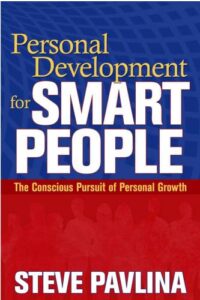
Explore Steve Pavlina’s ideas about truth, love and power through everyday examples and three questions for taking a first step towards change.
You want to learn a new skill, start a project, or change your daily routine. You read advice, save useful articles, and picture the result. But a week passes, then another, and very little changes in everyday life.
In Personal Development for Smart People, Steve Pavlina proposes looking at personal change through several connected principles. To begin exploring his approach, you can start with three questions: what is actually happening, what do you want, and what can you do?
Editor’s note. We explore Steve Pavlina’s model without presenting it as a scientifically established, universal method. The everyday examples and questions for reflection are editorial suggestions and do not guarantee a particular result.
What Pavlina’s approach is built on
Pavlina identifies seven principles of personal development. He considers three of them fundamental: Truth, Love, and Power. In his model, the other four—Oneness, Authority, Courage, and Intelligence—are connected to combinations of the first three. This is the author’s framework, rather than a set of established laws of human behaviour.
The book has two parts: Pavlina first explains the principles, then explores their application to habits, careers, and other areas of life. Here, we focus on the three foundations and the questions they can prompt before a small everyday change.
Truth: look at where you are starting
Pavlina devotes the first chapter to truth. In his introduction to that chapter, he invites readers to notice where they avoid uncomfortable information or fail to acknowledge their current situation.
In everyday life, you can turn this into a simple question: what exactly is happening now? Instead of “I am lazy,” try “For three evenings, I planned to study a language but only opened the lesson just before bed.” The first statement judges the whole person. The second describes a situation you can examine.
Perhaps the timing is inconvenient. Perhaps you do not know which exercise to begin with. Or the language may matter less to you right now than you thought. This is an illustrative example from the editors: it shows how to move from a general judgement about yourself to specific circumstances.
Love: work out why this matters to you
In Pavlina’s model, love extends beyond relationships between people. The author also describes connecting with ideas and activities that feel compatible with you. To explore a personal goal, we suggest asking: is there something in this that matters to me?
Imagine you have decided to start a blog. You enjoy learning about technology and explaining complicated things in simple language. That is one reason to write. A different situation is seeing someone else’s popular blog and wanting the same result, while having little interest in preparing the articles.
Both situations are worth considering honestly. You do not have to abandon a goal because it involves earning money or gaining recognition. But it helps to understand what you want to get from it and what work you are willing to do.
This example was created by the editors. It does not mean that an activity should be enjoyable all the time, or that a lack of interest necessarily explains your difficulties.
Power: find an action available to you
Pavlina’s third fundamental principle is power. In his explanation of the model, he connects it with a willingness to act rather than remain in reflection alone.
For a small project, one way to apply this is to choose an action you can actually influence. You cannot guarantee that a future blog will become popular. But you can outline one article, check one source, or write an introduction.
There is also a difference between doing the work and preparing to do it. If you want to write, choosing another notes app may be useful, but it does not create a piece of writing by itself.
Not every circumstance is within a person’s control. A lack of money, illness, family responsibilities, or unsafe conditions cannot be explained simply by insufficient determination. Your next step needs to account for real constraints.
Bring the three questions together in one example
Suppose you have wanted to learn video editing for a long time but keep putting it off. Here is an editorial example of looking at that task through the three foundations of the approach:
- What is happening? I open the program, see lots of tools, and do not know where to begin.
- Why do I want this? I want to put together short videos of my trips, rather than master every editing feature at once.
- What can I do? Choose three clips and try putting them in the right order.
Instead of promising to “finally get serious about editing,” you now have a specific task. Afterwards, you can decide what to learn next: trimming, transitions, or sound.
Three clips is an illustrative amount, not a rule from the book. The point is for the next step to be clear and relevant to your goal.
Try a small change in practice
You do not have to promise yourself a whole new way of life immediately. To begin, you can try one small change to your routine. For example, choose the exercise for your next study session in advance, so that you do not spend the available time searching.
After a few attempts, review what happened. Did you get started? What worked, and what got in the way? You may need a different time, a clearer explanation, or a smaller amount of work.
This is our suggested way to try the ideas in everyday life, rather than a separate exercise taken directly from the book. An unsuccessful attempt does not prove that you are incapable of change. It gives you a reason to reconsider the step you chose.
What you can take from the book to begin
Pavlina offers a broad model of personal development. You do not have to agree with every part of it to use a few questions when thinking about your own task.
What do I know about the current situation? Do I want this result? What action is available to me now? The answers will not predict success, but they can help you describe more clearly where you intend to start.
Find Personal Development for Smart People on Steve Pavlina’s official website.
Добавить комментарий